I am learning flutter from JustAcademy, They provide very much great environment where people gather and work simultaneously. totally project based training institute.
MOHD ABU BAKAR ANSARI
Flutter Developer
Awesome Experience. I am a Front-end Web Designer working at Star India for 3 years now. I applied for Full-stack development and my experience has been phenomenal & they really do help with placements exceptionally. Thank you Roshan sir so much.
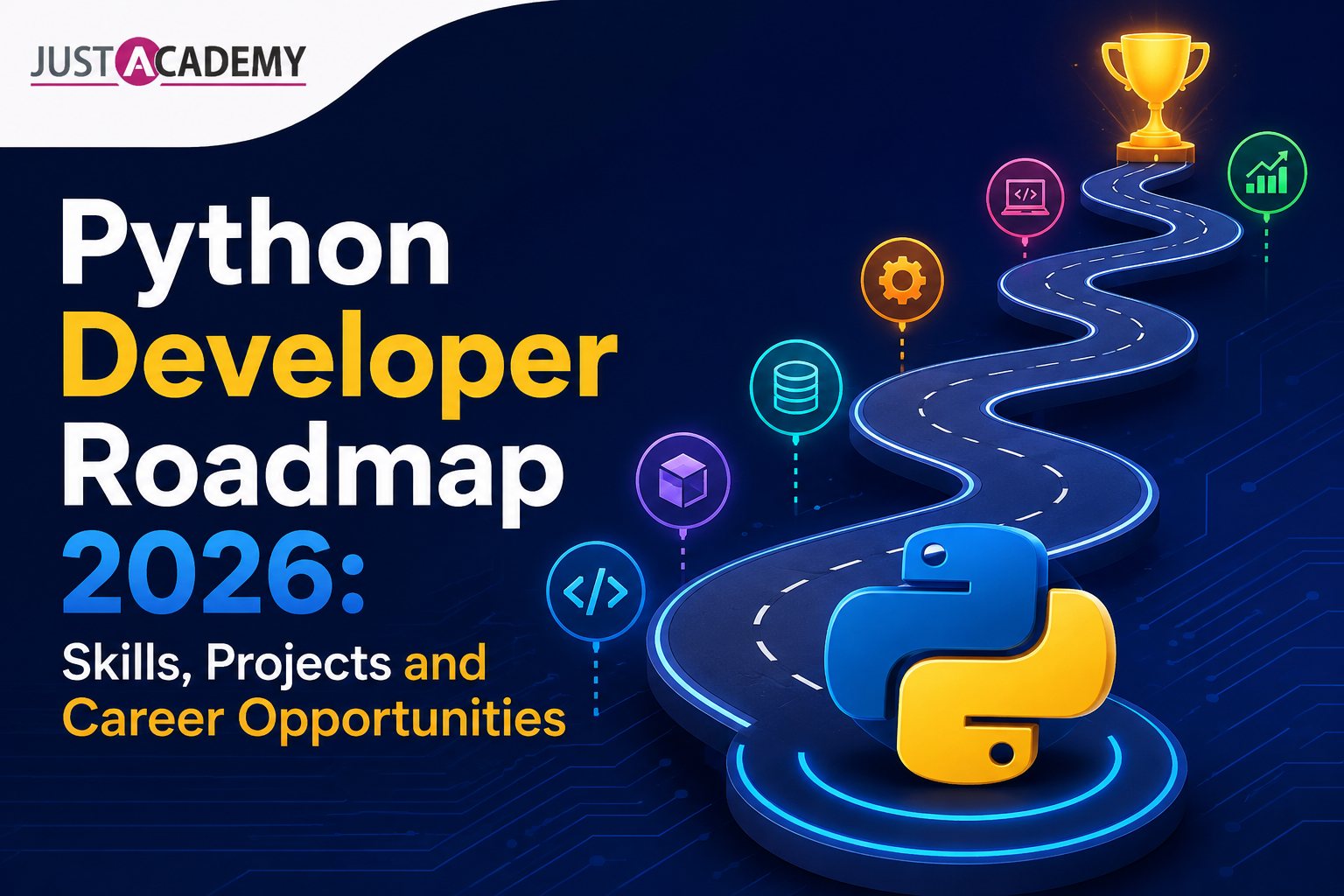
A practical, no fluff guide to becoming a job ready python developer in 2026, built around real skills, real projects and real salary numbers.
Every year someone predicts that a new language will finally push Python off its perch, and every year Python quietly proves them wrong. If you are reading this in 2026 and wondering whether a python developer career is still worth chasing, the short answer is yes, and the longer answer is that the game has changed just enough that you need a real plan instead of a random YouTube playlist. Recruiters are not impressed anymore by someone who can print "Hello World" or build a to do list app. They want people who understand how software actually gets used in production, who can reason about data, and who can walk into a team on day one without needing three weeks of hand holding.
That is exactly what this guide is for. We are going to walk through the entire python developer roadmap, from the first line of code you write to the kind of projects that make a hiring manager stop scrolling your resume. If you want to shortcut a lot of the trial and error, JustAcademy runs a python training in Mumbai program with live interactive sessions and placement support, and if you want to see how a class actually runs before committing, you can grab a seat on the free demo first. No pressure either way, just useful information ahead.
Before we get into the roadmap itself, it helps to understand why this particular moment matters so much. Companies across banking, healthcare, retail, logistics, and even manufacturing are now running python somewhere in their stack, whether that is a backend API, a data pipeline, an internal automation tool, or a full blown machine learning model. This spread across industries is exactly why python jobs keep multiplying even as some other tech roles slow down. A single skill set now opens doors in dozens of unrelated sectors, which is a rare thing in a job market that usually rewards narrow specialization.
Decoding The Path: How Skills Stack Up From Zero To Hire
The biggest mistake freshers make with python developer jobs for freshers is treating learning like a checklist instead of a staircase. You do not need to know everything at once, you need to know the right thing at the right stage, and trying to learn Django before you are comfortable with basic loops usually backfires badly.
Stage one, the foundations that never expire
This is variables, loops, functions, data structures like lists and dictionaries, and enough object oriented programming to understand why classes exist. Skip this stage too fast and every advanced topic you touch later will feel shaky. Most people rush here because it feels boring compared to building an app, but this is where a python developer's actual thinking gets shaped. Spend real time writing small scripts that solve annoying everyday problems, like renaming a batch of files or calculating your monthly expenses, because that kind of practical repetition builds instinct faster than watching hours of theory.
Stage two, working with real data
Once the basics are solid, you move into file handling, working with APIs, and libraries like pandas and numpy. This is also where a lot of learners quietly drift toward data roles without even planning it, because pandas is genuinely addictive once you see how fast it slices through a messy spreadsheet. This stage also introduces you to the idea of clean code, meaning code that someone else on your team could open and actually understand without you sitting next to them explaining every line.
Stage three, building things that live on the internet
This is where frameworks like Django and Flask enter the picture. You start building actual web applications with routes, databases, and authentication, and this is the stage that turns "I know python" into "I can ship a product." Most beginners underestimate how much they learn here simply by debugging their own broken code at two in the morning, because that frustration is exactly what builds the problem solving muscle interviewers are testing for.
Stage four, deployment and working like a real team
This is the stage almost every self taught learner skips, and it is the one that quietly decides whether you get hired. Learning to deploy a project on a basic cloud platform, understanding environment variables, and getting comfortable with simple Docker concepts turns a classroom project into something that behaves like real software. Pair that with disciplined Git habits, writing clear commit messages, opening pull requests, and reviewing code the way an actual engineering team would, and you stop looking like a student and start looking like a colleague.
The Toolbox That Actually Gets You Hired
If you ask ten different python developers what skills matter most, you will get ten different answers, but a few names show up again and again, and this is the toolbox worth focusing your energy on.
Django and the web development world
Django jobs and django developer jobs remain some of the most consistently posted roles on every job portal in India. Django gives you an entire framework for building secure, scalable applications quickly, and companies love it because it does not require reinventing basic things like user login or admin panels every single time.
SQL, because data never stops mattering
A python developer who cannot write a clean SQL query is going to struggle the moment a real project starts. Databases are everywhere, and knowing how to pull, filter, and join data is non negotiable, no matter which specific direction your python developer career eventually takes.
Git and version control
This sounds obvious but it trips up more freshers than anything else. If you cannot push a branch, resolve a merge conflict, or write a sensible commit message, that is usually the first red flag in a technical interview, even before the interviewer looks closely at your actual code.
REST APIs and how systems talk to each other
Modern applications are rarely just one piece of code sitting alone. They talk to other services, they pull data from third party APIs, they push notifications. Understanding how requests and responses work is a skill that applies whether you end up in backend development, automation, or data work.
Testing your own code
This is the one skill fresher resumes almost never mention, and it is exactly why experienced developers get picked over freshers for mid level roles. If you can write basic unit tests, you instantly look more employable. If testing interests you specifically, JustAcademy also runs a selenium training in Mumbai program that pairs well with a python background for anyone eyeing quality assurance or automation roles.
Cloud basics and communication skills
You do not need to become a cloud architect, but knowing how to deploy a simple application on a platform like AWS or basic hosting services, and knowing how to explain your work clearly to a non technical manager, quietly separates candidates who get promoted faster from candidates who stay stuck writing the same kind of ticket for years.
If You Want To Go Full Stack With Python
Here is something a lot of python learners do not realize until later: python developer positions increasingly expect at least a working knowledge of the front end. You do not need to become a designer, but understanding how a browser renders a page and how the front end talks to your backend makes you dramatically more useful on a team.
This is where a full stack python developer path starts to make sense. Pairing your python backend skills with front end basics turns you from someone who writes isolated scripts into someone who can own a feature end to end. If you want to build that bridge properly, a javascript training in Mumbai alongside your python learning is one of the fastest ways to make yourself relevant for python full stack developer jobs, which tend to pay noticeably more than backend only roles because you are effectively doing the work of two specialists.
Some learners take this even further by combining python with a proper MERN based approach for team projects that need a modern front end stack. If that route interests you, the MERN stack developer bootcamp in Mumbai is built around exactly that kind of hands on, project heavy training with a classroom setting for people who learn best with real time guidance. Even if your long term goal is a purely backend python developer role, understanding how a front end team thinks makes you noticeably easier to work with, and that soft advantage shows up in performance reviews more often than people expect.
Real Projects, Real Proof: Building A Portfolio Recruiters Notice
Nobody hires a python developer based on a certificate alone anymore. What actually gets attention is a portfolio that shows judgment, not just syntax. Here are project categories that consistently do well in interviews.
A personal finance tracker that pulls data from a CSV or an API, cleans it, and visualizes spending patterns shows you understand both data handling and basic analysis, which matters even if you are not applying for a pure data role.
A small e commerce backend built with Django, complete with user authentication, a product catalog, and an order system, demonstrates that you understand how a real application is structured, not just how to print output to a console.
An automation script that scrapes public data, cleans it, and stores it somewhere useful is a favorite among interviewers because it proves you can handle messy, unpredictable input, which is what real jobs actually look like day to day.
A REST API you built from scratch, documented properly, and tested with tools like Postman shows recruiters you understand how modern systems are built to be consumed by other applications, not just used by a single user clicking buttons.
A small dashboard project that connects your python backend to a simple visualization layer also works extremely well as a portfolio piece, because it shows you can take raw numbers all the way through to something a non technical stakeholder can actually understand at a glance.
The pattern here is simple. Each project should answer a question a hiring manager actually cares about: can this person take a vague problem and turn it into working software without constant supervision. Quality matters far more than quantity here, so three well documented, genuinely working projects will always beat ten half finished repositories sitting untouched on your GitHub profile.
Where Python Takes You: Career Lanes Beyond Just Coding
One of the most underrated things about a python developer career path is how many directions it can branch into. This is not a language that locks you into one job title for life.
The classic software developer route
This is your standard python software developer jobs, building applications, APIs, and backend systems for companies across every industry imaginable, from fintech to healthcare to logistics. Developers on this path often move into architecture or team lead roles within a few years, since python's readability makes it easier for senior developers to mentor and review code across a growing team.
The data science and analytics route
Data scientist python roles have exploded over the last few years, and for good reason. Python for data scientists is basically the industry default at this point, thanks to libraries like pandas, scikit learn, and matplotlib making it far easier to go from raw numbers to actual insight. If data visualization interests you specifically, a Microsoft Power BI training in Mumbai pairs extremely well with python skills, since companies love candidates who can both process the data and present it in a way leadership actually understands.
For anyone who wants to go deeper into the analytics side as a structured, project heavy program rather than piecing skills together on their own, the data analytics bootcamp in Mumbai is designed around exactly that, combining python, SQL, and visualization tools into one connected learning track.
The automation and scripting route
Not every python job involves building customer facing products. A huge number of companies hire python developers purely to automate repetitive internal processes, from generating reports to managing infrastructure, and these roles often fly under the radar compared to flashier job titles, even though they can be some of the most stable and consistently in demand positions in a company.
The remote and freelance route
Python remote jobs have become genuinely common, partly because the language is so widely used across industries that companies do not need someone physically in an office to get value from a good developer. If location flexibility matters to you, python is one of the safer languages to bet on for that kind of career, and freelance platforms consistently list python among the most requested skills for short term project based work as well.
Python In The Real World: Where 2026 Demand Is Actually Coming From
It helps to see where the actual job postings are concentrated rather than relying on assumptions. Fintech companies use python heavily for fraud detection, risk modeling, and backend transaction systems. Healthcare and pharma companies use it for research data analysis and building internal patient management tools. E commerce platforms rely on it for recommendation systems and inventory automation. Even traditional manufacturing companies now hire python developers to build predictive maintenance tools that flag equipment issues before they cause downtime.
This spread matters because it means your job search does not have to be limited to pure IT companies. A python developer with even basic domain knowledge in finance, healthcare, or retail becomes noticeably more attractive to companies in those specific sectors, since they are effectively getting someone who understands both the code and the business problem it is solving.
Common Mistakes That Quietly Slow Down A Python Developer Career
A lot of learners do everything right on the technical side and still struggle to land interviews, usually because of a handful of avoidable habits. Spending months on tutorials without ever building an original, unguided project is one of the most common traps, since tutorial following builds familiarity but not real problem solving ability. Ignoring the basics of how the web works, like HTTP methods and status codes, is another gap that shows up embarrassingly fast in interviews. Applying only to large, well known companies while ignoring smaller startups and mid sized firms also limits opportunities unnecessarily, since smaller companies are often far more willing to take a chance on a promising fresher. Finally, treating the job search as a one time event instead of a consistent weekly habit, applying broadly, following up, and refining your resume based on feedback, tends to be the difference between a two month search and a six month search.
The Money Talk: Python Developer Salary In India And Beyond
Let us talk numbers, because vague promises about "great career opportunities" mean nothing without actual figures. Python developer salary in India varies a lot based on experience, city, and specialization, but here is a realistic picture based on current market patterns.
Experience Level
Typical Role
Approximate Annual Salary (India)
0 to 1 year
Junior python developer jobs, trainee roles
3 to 5 lakh
1 to 3 years
Python developer, django developer
5 to 9 lakh
3 to 6 years
Senior python developer, python full stack developer
9 to 18 lakh
6+ years with data specialization
Data scientist python, lead developer
18 to 30 lakh and above
Indeed python developer jobs and similar listings across major portals consistently show that specialization pushes salaries up faster than years of experience alone. A developer who pairs python with data skills, or with a full stack skill set, tends to move up the salary ladder noticeably faster than someone who stays purely backend focused without expanding their range. City also plays a real role in this, with Mumbai, Pune, Bangalore, and Hyderabad generally offering higher starting figures than smaller cities, though remote python jobs have started narrowing that gap considerably, since companies increasingly pay based on skill rather than location alone. Freelance python work adds another layer to this picture, with experienced freelancers on project based contracts often earning more per hour than an equivalent full time salary would suggest, though obviously without the stability of a fixed monthly income.
From Learner To Employee: Why Structured Training Actually Works
Here is something almost every self taught developer admits eventually. Learning python on your own from scattered tutorials works, but it takes far longer and leaves gaps you do not even know exist until an interviewer finds them for you.
This is exactly the gap that structured, live interactive sessions are designed to close. Instead of guessing what to learn next, a guided curriculum takes you through the same python developer roadmap this article has described, but with someone correcting your mistakes in real time and with actual projects reviewed by an instructor instead of a comment section. This also solves one of the quietest problems self taught learners face, which is not knowing what you do not know, since a structured mentor can flag a gap in your understanding long before it becomes a problem in a real interview.
JustAcademy has built its reputation as one of the best course in Mumbai options precisely because of this approach, combining classroom training in Mumbai and Pune with live interactive sessions available to learners anywhere in the world. Every batch is built around real projects, not just theory, and every learner gets dedicated placement support once they are ready to start applying. If you want to read more about how the training approach connects to actual outcomes, this detailed breakdown of the python institute experience is worth a look.
Whether you are exploring python developer guide content on your own or you are already comparing training options, the honest advice is this: pick a structured path that forces you to build, not just watch. Passive learning feels productive but rarely survives contact with a real interview.
How To Prepare For Your First Python Interview
A few practical habits separate candidates who get offers from candidates who get ghosted after the first round.
Practice explaining your projects out loud, not just building them. Interviewers care as much about how you think through a problem as they do about the final code, and being able to walk someone through your reasoning clearly often matters more than getting every small detail technically perfect.
Revise core data structures and basic algorithmic thinking regularly, even if your target role is not algorithm heavy. Most companies still test this at some level, usually as a way of checking how you approach an unfamiliar problem rather than testing memorization.
Keep your GitHub clean and updated. A messy, half finished repository does more damage than an empty one, since it signals inconsistency rather than simply signaling inexperience.
Research the company before every interview, even a first round screening call. Knowing roughly what the company builds and why python fits their stack shows genuine interest, and interviewers notice the difference between a candidate who prepared and one who did not.
Apply broadly across python jobs, python related jobs, and even adjacent listings like python developer hire postings from smaller companies, since your first role does not need to be your dream role, it just needs to get your foot in the door.
Final Word: Your 2026 Action Plan
The python developer future scope remains genuinely strong heading into 2026, and demand is not slowing down across data, web development, and automation roles. What separates the people who land python developer job opportunities from the people who stay stuck applying for months usually comes down to structure, consistency, and real project experience rather than raw talent. Give yourself a realistic timeline, stay consistent even on the days motivation is low, and treat every rejection as feedback rather than a verdict on your ability.
If you are ready to stop guessing and start following an actual roadmap with people who will answer your questions instead of leaving you to figure it out alone, JustAcademy's live interactive python training is built exactly for that. You can book your free demo to see a class firsthand, or download the course brochure to go through the full curriculum at your own pace before making a decision.
Your python developer career does not need to start perfectly. It just needs to start .
Decoding The Path: How Skills Stack Up From Zero To Hire
The Toolbox That Actually Gets You Hired
Where Python Takes You: Career Lanes Beyond Just Coding
The Money Talk: Python Developer Salary In India And Beyond
40 real questions and detailed answers on Kotlin, Jetpack, architecture, performance and security, so you walk into your next android technical interview ready to talk like a working developer.
From your first line of JavaScript to a react native app on the Play Store and App Store, here is the honest, practical route that beginners in India can actually follow.
A practical, Pune focused guide to learning ui ux design with live, instructor led and mentor led Figma training, from your first frame to your first job offer.
A Pune learner's roadmap to picking the right tools for Selenium, building a framework from scratch, and understanding where BDD, Cypress, Playwright and Appium fit into the bigger QA picture
Drop us a Query
+91 99871 84296
Available 24x7 for your queries
Want To Connect with us
🚀 Kickstart Your IT Career
with JustAcademy
Learn Industry-Focused Courses with Live Projects & Placement Assistance
Full Stack Java(Java, Spring Boot, Hibernate, REST API, React JS)
Data Analytics(Excel, SQL, Power BI, Python, Tableau)